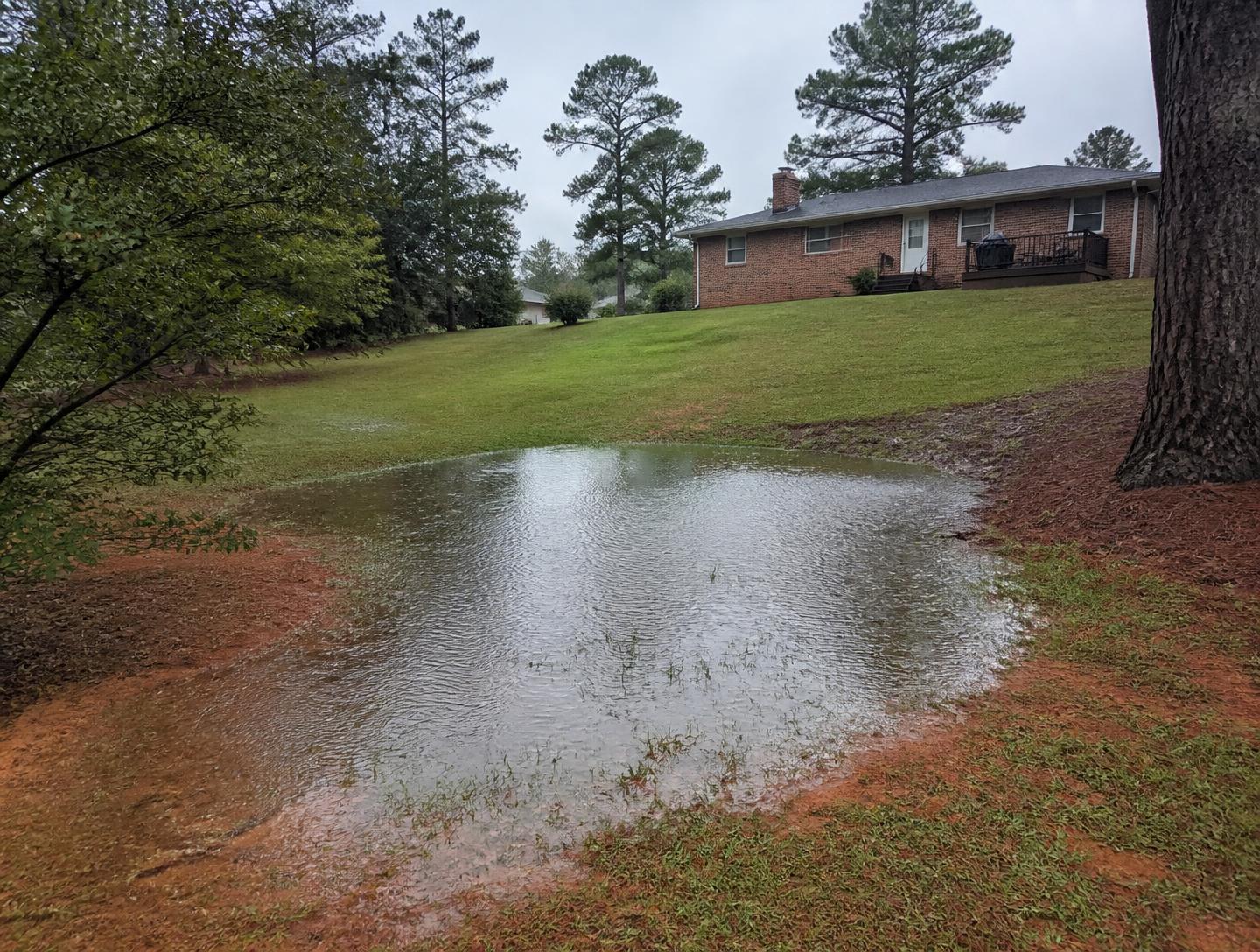
There is no default answer here. A French drain is one option among several, and recommending it for every wet yard is how homeowners end up paying for a system that does not match the problem.
Cause 1 — Roof water discharging too close to the house
The most common and most fixable cause. Gutters concentrate an entire roof plane into one outlet, and a splash block releases it within a few feet of the foundation. Look for a washed-out bed, a bare clay channel below the downspout, and a wet strip that follows the house line.
- Likely direction: buried downspout lines to a lower discharge point, sometimes with a catch basin.
Cause 2 — Negative or flat grade
If the ground does not fall away from the house or from a patio edge, water has no reason to leave. Settlement around newer Upstate homes and raised landscape beds both create this quietly, years after construction.
- Likely direction: regrading, sometimes combined with a shallow swale.
Cause 3 — A true low point in the lawn
A defined bowl that collects surface water from a wide area. It fills fast during a storm and then sits, because clay soil below it releases water slowly.
- Likely direction: a catch basin with a piped outlet, or filling and regrading if a downhill path exists.
Cause 4 — Soil saturation across a broad area
The lawn is not holding a visible puddle so much as staying spongy for days. Footprints leave impressions and mowing tears the turf. This is subsurface water rather than surface water.
- Likely direction: a French drain intercepting the flow upslope of the wet zone.
Cause 5 — Runoff arriving from uphill
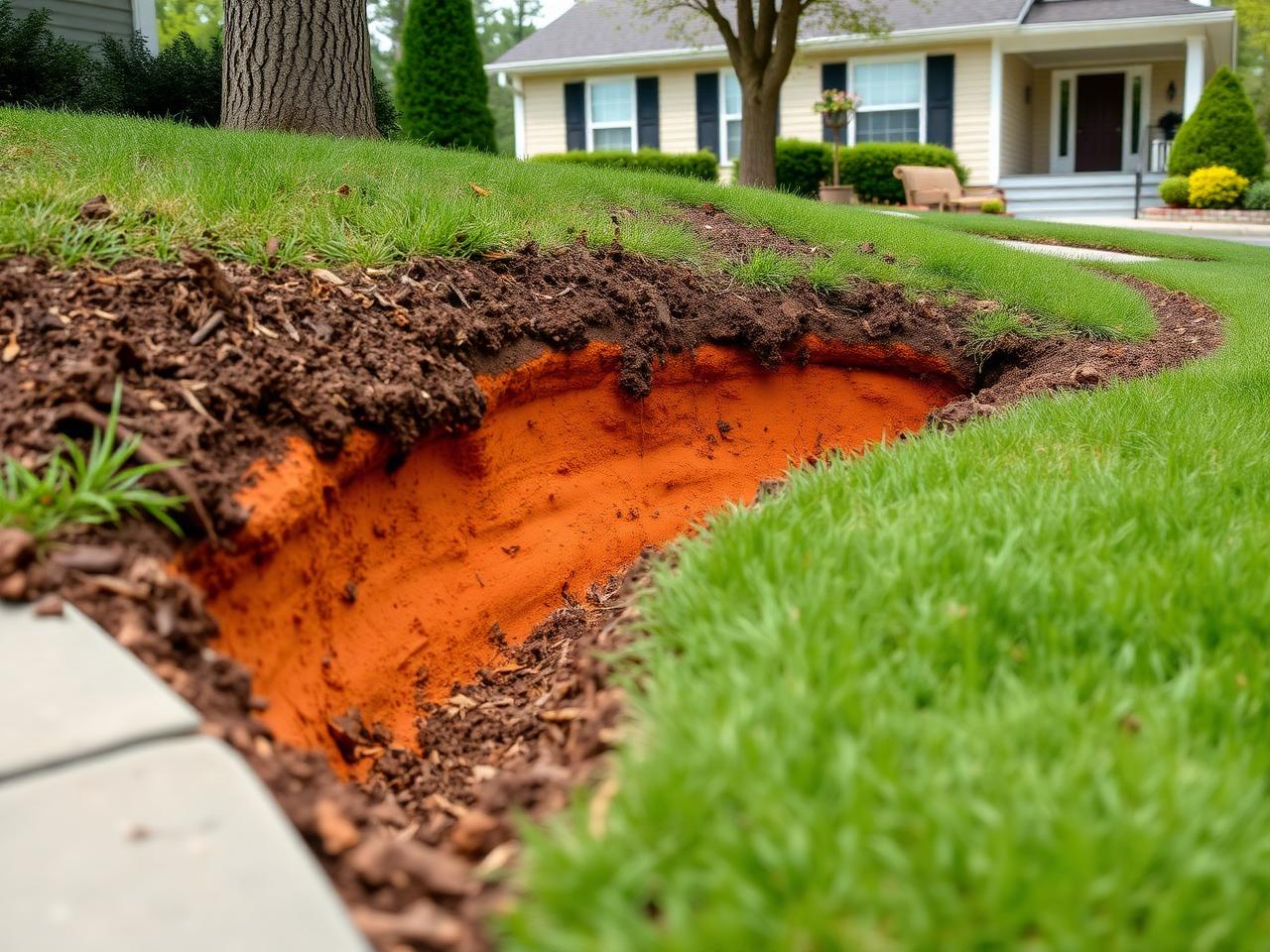
Water that is not yours
On sloped Upstate subdivisions, water routinely crosses two or three properties before it reaches a bottom lot. Silt lines, eroded clay channels and washed mulch along a boundary are the tell.
Solving it downstream is expensive. Intercepting it at the property line with a swale or drain line is usually the more practical route, provided the discharge does not create a new problem for someone else.
- Likely direction: a boundary swale, an interception drain, or shaped grading along the upper edge.
Cause 6 — An existing system that stopped working
Water standing directly over an older drain line, or an outlet that no longer runs during rain, points to a failed system rather than a missing one. Buried outlets and silted aggregate are the leading culprits in clay country.
- Likely direction: French drain repair, or a rebuild of the section that matters.
Compacted soil and thatch: contributing factors, not causes
Heavy compaction from construction traffic or years of mowing reduces how quickly water enters the soil, and it makes clay behave even more like clay. Aeration and soil improvement help a marginal area, but they do not resolve a yard that receives more water than it can shed.
Health and property concerns worth noting
- Standing water supports mosquito breeding during Upstate summers.
- Persistently saturated soil against a foundation is worth addressing early.
- Repeated saturation kills turf and creates bare clay, which then erodes.
- Soft, wet ground damages easily under mowers and foot traffic.
Questions homeowners ask
How long is too long for water to stand in a yard?
Water that clears within several hours after rain stops is generally not a structural concern. Water that remains for a day or more, storm after storm, indicates the yard has no working outlet for it.
Can I fix a soggy yard by adding topsoil?
Filling a low spot only works if there is somewhere for the displaced water to go. Without a downhill path, added soil moves the puddle rather than removing it.
Does aerating help with standing water in clay?
Aeration can improve infiltration in mildly compacted turf, and it is worth doing for lawn health. It rarely resolves a persistent standing water problem on its own in Upstate clay.
Which solution is cheapest?
Grading and downspout rerouting are often the least expensive corrections when they match the cause. Cost rises with excavation depth, pipe length and restoration, which is why matching the cause matters financially as well as technically.
Keep reading
Still not sure which cause is yours?
That is what the project request is for. Describe what you see after a storm and a professional can work backward from it.