Where a linear drain earns its place
Garage apron
Across the drive just outside the garage door, intercepting water running down toward the slab.
Bottom of a sloped driveway
Common on Upstate hillside lots where the drive falls toward the house rather than the street.
Patio to lawn transition
Where hardscape runoff dumps onto turf and cuts a channel through the clay.
Walkout basement or courtyard
Below-grade doorways that collect everything the surrounding grade delivers.
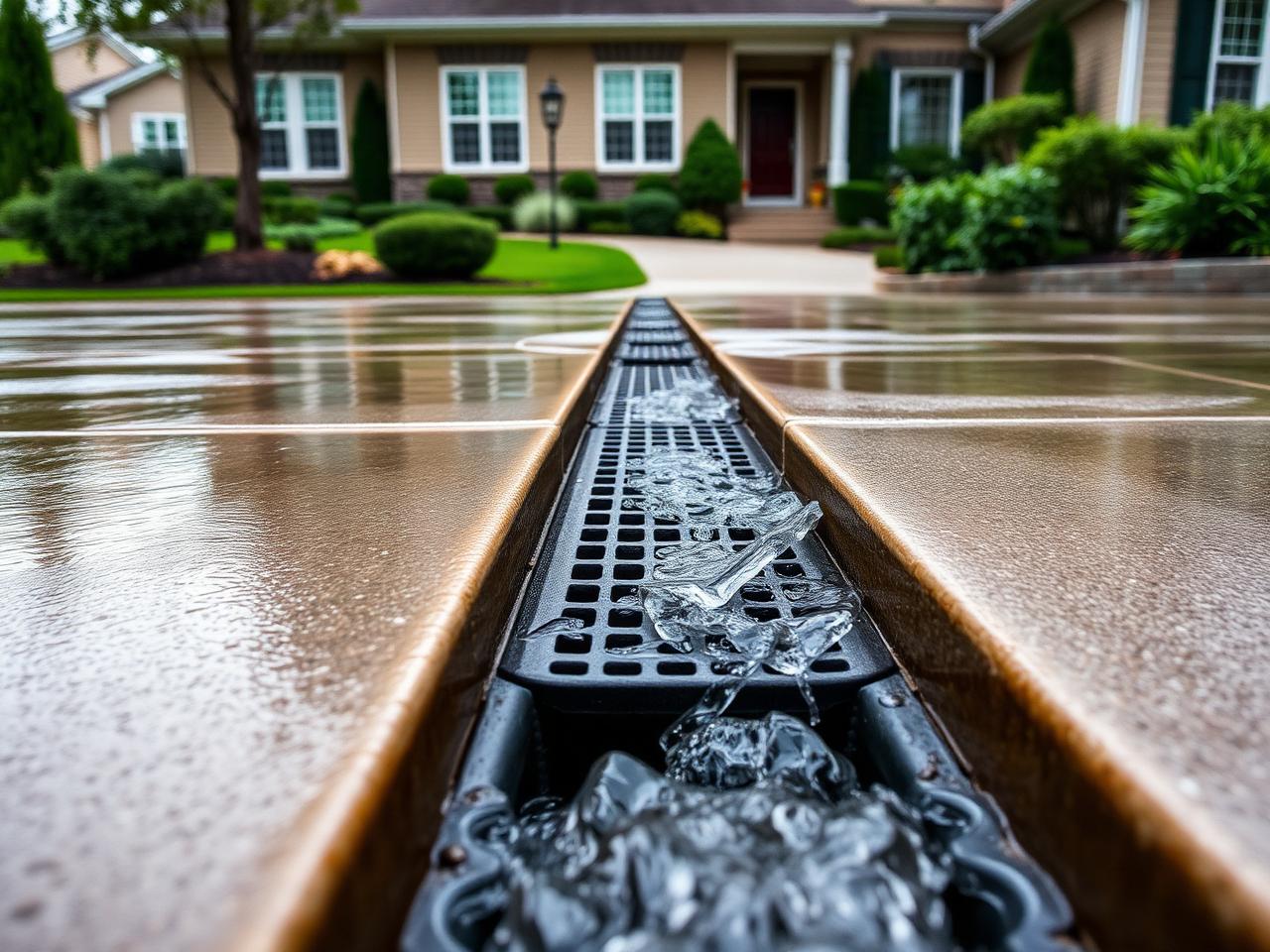
Installation is a concrete job as much as a drainage job
A trench drain is cut into or formed within the hard surface, set to exact elevation, and encased in concrete so it cannot shift or heave under vehicle loads. The channel itself is usually pre-sloped or set with built-in fall so water runs to the outlet end.
The outlet pipe is where most retrofits get complicated. It has to leave the channel below the surface, keep continuous fall, and reach a discharge point — often a catch basin or a daylight outlet at the low corner of the lot.
Specification details that matter
- Grate load rating — a driveway channel must be rated for vehicle traffic, not pedestrian only.
- Channel width and depth, sized to the contributing area of pavement above it.
- Outlet position — end outlet or bottom outlet, depending on where the pipe can run.
- Frame anchoring, so the grate edge stays level with the concrete over time.
- Sediment access, since grit and clay wash off pavement continuously in the Upstate.
Channel drain or catch basin?
Symptom
Water arrives as a wide sheet
- Runoff crosses the full width of a driveway or patio.
- There is no single low point to aim at.
- A linear channel intercepts across the whole path.
Likely direction
Water arrives at one point
- A defined dip collects everything.
- A single grated basin captures it more cheaply.
- Basins are often paired downstream of a channel run.
A channel drain across a driveway does not solve a driveway that pitches toward the house. Interception buys control; grade determines how much water arrives in the first place.
Questions homeowners ask
Can a trench drain be added to an existing concrete driveway?
Yes. A section of the slab is saw-cut and removed, the channel is set and encased, and the concrete is patched. The finish seam is visible, so the cut line is usually planned along a control joint where possible.
What grate material holds up best?
Grate choice balances load rating, appearance and cost. Driveway applications need a rating suited to vehicle traffic; polymer, galvanized steel and ductile iron are all used depending on the application.
Where does the water go after the channel?
Into solid outlet pipe, and then to a lower discharge point — commonly a daylight outlet, a catch basin, or a tie-in to an existing yard drain trunk line with capacity to spare.
Do channel drains clog?
They collect leaves, pine straw and grit, all of which are plentiful in Upstate yards. Lifting the grate and clearing the channel a couple of times a year keeps flow capacity up.
Keep reading
Water crossing your driveway or patio?
Describe where it enters the hard surface and where it ends up. Photos during rain are especially useful here.