How the installation is built
- 01The line is laid out along the path water already travels, or across the slope above the area being protected.
- 02A trench is excavated to a consistent depth with continuous fall toward the outlet — no flat runs, no back-pitch.
- 03Filter fabric lines the trench so clay fines do not migrate into the stone over time.
- 04Perforated pipe is bedded in washed stone, not screenings and not native clay backfill.
- 05More washed stone covers the pipe, the fabric is wrapped over the top, and the trench is finished with soil and turf or left as a stone-topped line where appropriate.
- 06The outlet is set to daylight at a lower elevation, or into a collection structure that has its own outlet.
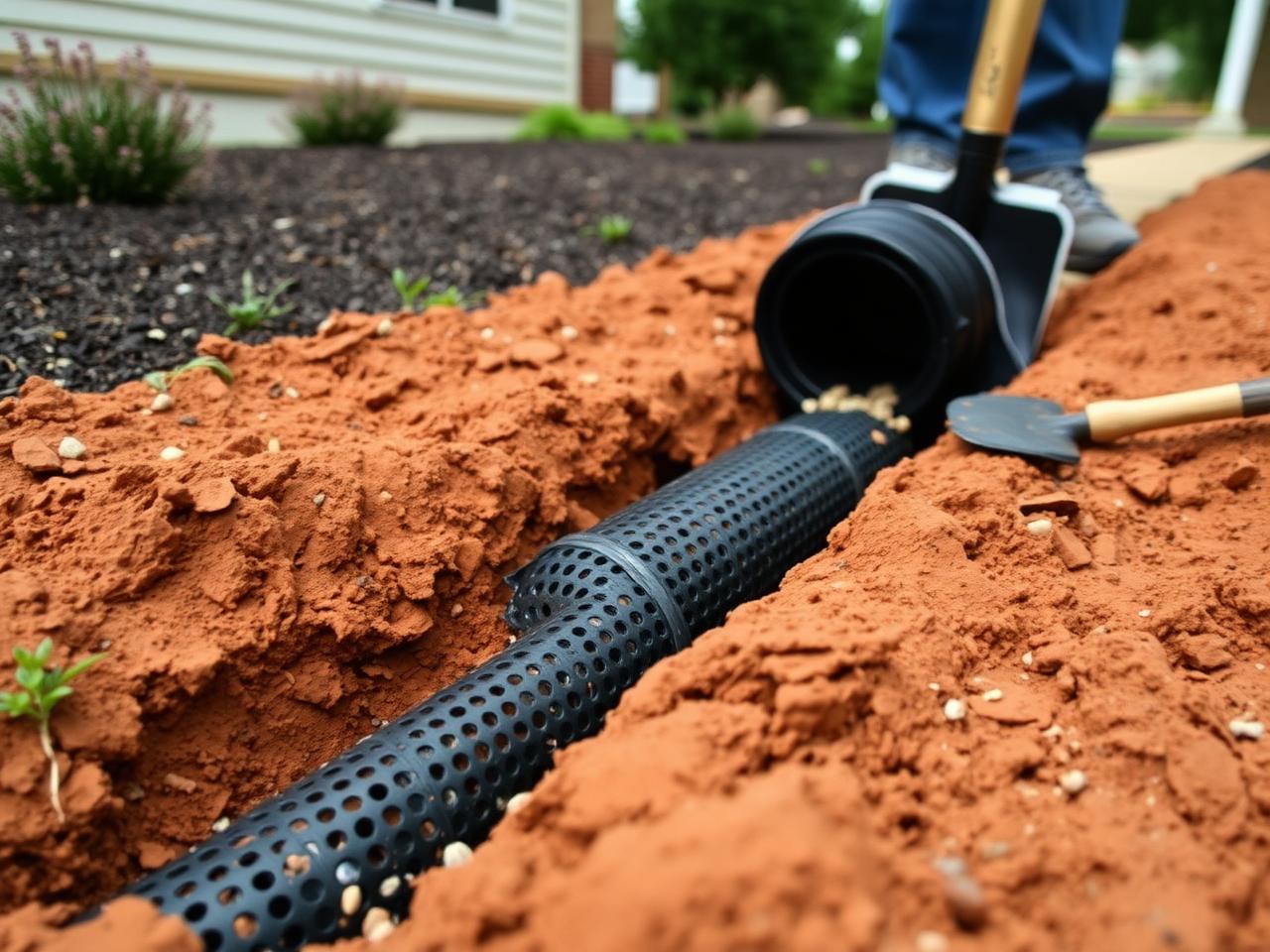
Washed stone and fabric are not optional here
Upstate red clay carries very fine particles. When those fines wash into the aggregate around a drain line, the void space that lets water move disappears, and the drain slowly stops accepting water.
That is the single most common reason a French drain installed a few years ago in Greenville now sits under a puddle. Filter fabric, clean washed stone and a correctly sized pipe are what buy the system its working life.
When a French drain is the right call — and when it is not
Symptom
A French drain usually fits
- A broad area of lawn that stays saturated rather than one defined puddle.
- Water moving downhill through the soil toward a house or patio.
- A slope where runoff needs interception before it reaches a lower flat area.
- Chronically wet ground along a fence line or property boundary.
Likely direction
Something else usually fits better
- One clear low point holding surface water → a catch basin.
- Roof water dumping beside the foundation → buried downspouts.
- Sheet flow crossing a driveway → a channel drain.
- Negative slope toward the house → regrading first.
What affects the design on Greenville lots
- Linear footage and how much of the run is uphill of the wet area.
- Trench depth, which increases sharply where clay is dense or rock is present.
- Access for equipment — narrow side yards often mean hand digging.
- Whether the line can daylight or has to be pumped.
- How much lawn, bed or hardscape restoration the route requires.
Every French drain needs somewhere to go. On a flat lot with no lower point, the honest answer may be grading, a basin-and-pump system, or a different approach entirely.
Questions homeowners ask
How deep should a French drain be in Upstate clay?
Depth depends on what the drain is intercepting and how much fall is available to the outlet. A shallow line can handle surface saturation, while intercepting water moving toward a foundation usually calls for a deeper trench. The controlling factor is maintaining continuous slope to the discharge point.
Will a French drain fix water in my crawlspace?
It can reduce the volume of water reaching the foundation when the source is surface and shallow subsurface water. It is not a substitute for interior water management or foundation repair when the cause is different, so the source should be identified first.
Can a French drain be installed under an existing lawn without destroying it?
The trench line itself is disturbed and needs restoration, but the surrounding lawn generally stays intact. Restoration scope — seed versus sod, bed repair, hardscape cuts — is part of what shapes project cost.
How long does a French drain last?
Working life depends on installation quality and on how much silt the system sees. Systems built with filter fabric, washed stone and a clear outlet last considerably longer than lines backfilled with native clay soil.
Keep reading
Not sure a French drain is what your yard needs?
Send photos and a short description. The right answer is sometimes a drain line, and sometimes just a change in grade.