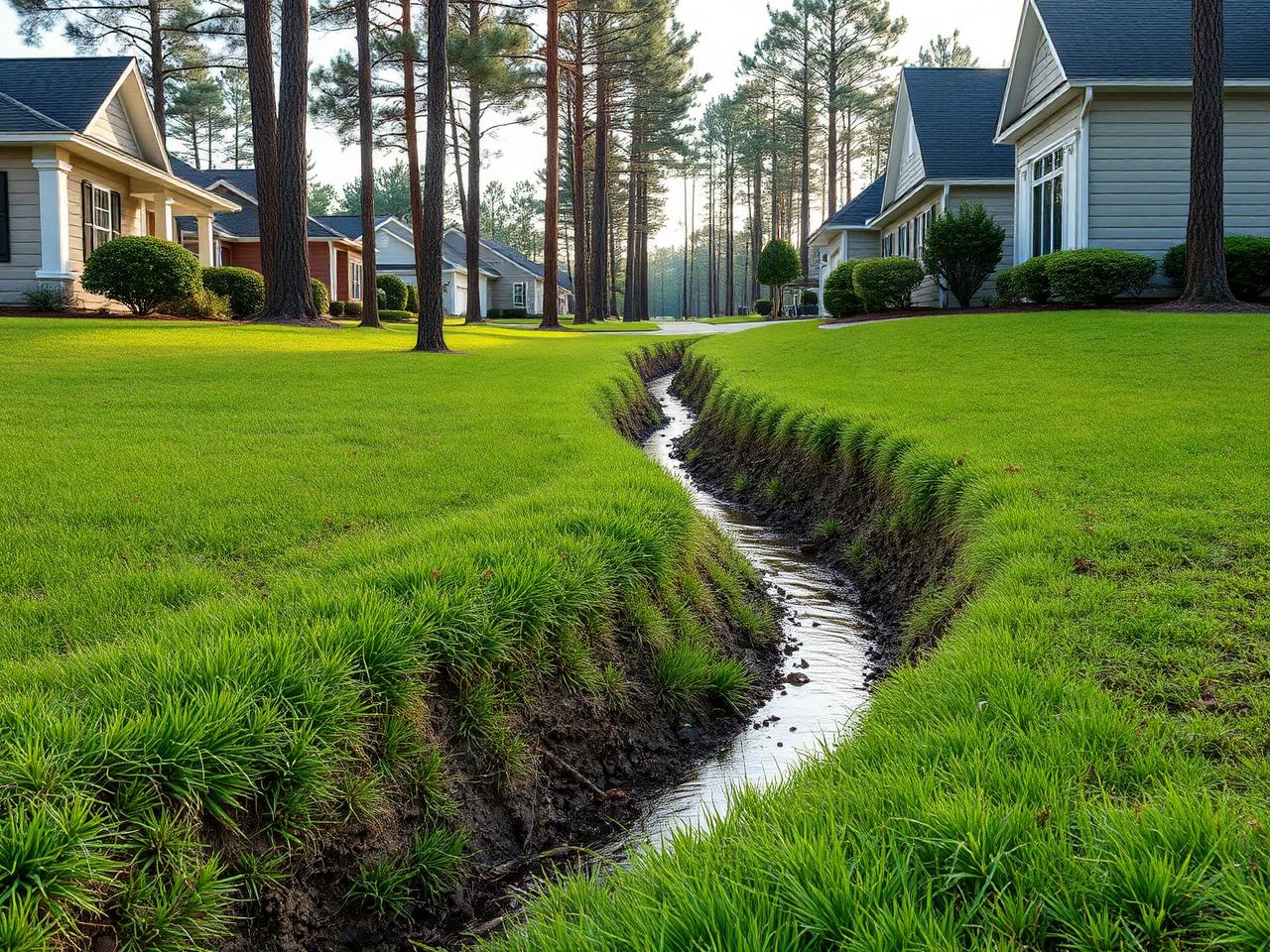
What a swale does well
Swales handle large volumes of surface water without the capacity limits of a pipe. They slow flow, spread it, and guide it along a route the property owner chooses instead of the one erosion picked.
They also cost less per foot than a piped system in most cases, need no cleanouts, and are easy to inspect — you can see exactly what the channel is doing during a storm.
Where swales fit on Upstate properties
- Along a property line where runoff arrives from an uphill neighbor.
- Between a sloped rear yard and a house sitting lower on the lot.
- Above a driveway, catching flow before it reaches pavement.
- Across a large open lawn where a piped system would be long and expensive.
- As the receiving channel for a French drain or downspout outlet.
Building a swale that holds up in red clay
- 01Establish the route and confirm continuous fall from the top of the run to the discharge area.
- 02Shape a broad, shallow cross-section rather than a narrow ditch — width reduces velocity and erosion.
- 03Amend and prepare the surface so turf establishes; bare clay in a flow path scours quickly.
- 04Stabilize with sod, seed and erosion matting, or with stone armoring where flow concentrates.
- 05Where slope is steep, add check features so water steps down instead of accelerating.
Swale, French drain, or both?
Symptom
Choose a swale when
- Water is on the surface, not in the soil.
- There is room for an open channel.
- Volume is high and the route is long.
- Budget favors earthwork over pipe.
Likely direction
Add a drain line when
- The ground stays saturated between storms.
- The route crosses a lawn area in active use.
- The channel would be too steep to stabilize.
- The discharge has to pass under a walk or drive.
A swale is a maintained feature, not a set-and-forget one. Mowing height, leaf buildup and edge erosion all affect how it performs over the years.
Questions homeowners ask
Is a swale just a ditch?
A ditch is usually narrow and steep-sided; a swale is broad and shallow with a stabilized surface designed to carry water at low velocity. The shape is what makes it mowable and resistant to erosion.
Will a swale make my yard hard to use?
A well-shaped swale is gentle enough to walk and mow across. Depth and side slopes are chosen to carry the expected flow without creating an obstacle in the lawn.
Can a swale be planted rather than grassed?
Yes. Vegetated swales with appropriate plantings can work well, provided the planting scheme tolerates periodic saturation and the flow path stays clear.
How much land does a swale need?
Enough width to keep the sides gentle and enough length to maintain fall to the outlet. Tight side yards between Upstate homes often lack the room, which is where a piped solution takes over.
Keep reading
Runoff crossing your property?
Describe where the water enters your lot and where it exits. A swale route is decided by those two points.